The Kaizen Event


The Kaizen Event (Rapid Improvement Event) in Lean
Image

What is a Kaizen Event?

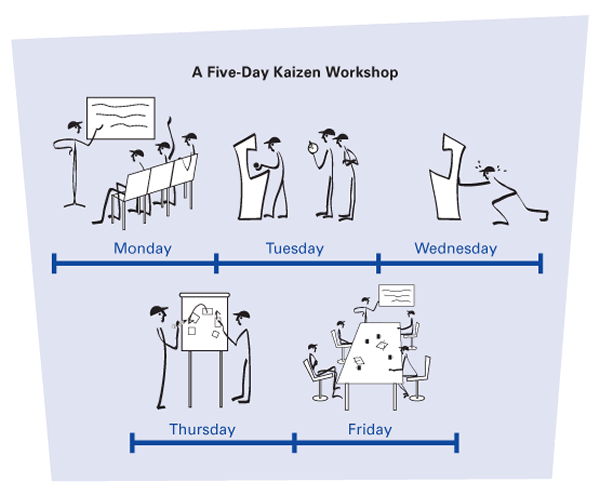
A Kaizen Event is a short, focused, team-based improvement effort—typically 3 to 5 days—designed to achieve rapid, measurable improvements in a specific process.

Kaizen means continuous improvement.
A Kaizen Event is improvement at high speed.


Why Organizations Use Kaizen Events

  • Deliver quick wins

  • Reduce waste (Lean focus)

  • Improve quality, cost, delivery, and safety

  • Engage frontline employees

  • Turn analysis into immediate action


When to Use a Kaizen Event

Use a Kaizen Event when:

  • The problem is well-defined

  • The process is localized

  • Solutions are known or testable

  • Leadership support is available

  • Rapid improvement is needed

❌ Not ideal for highly complex, cross-enterprise problems (use DMAIC instead).


Typical Duration & Team

  • Duration: 3–5 days

  • Team size: 6–10 members

  • Team makeup:

    • Process owner

    • Frontline operators

    • Subject matter experts

    • Lean facilitator

    • Management sponsor


Kaizen Event Phases (Day-by-Day)

Image

Image

Image

Day 0 – Preparation (Before the Event)

  • Define problem & scope

  • Collect baseline data

  • Select team & logistics

  • Set clear targets

📌 Preparation determines success.


Day 1 – Understand Current State

  • Process walk (Gemba)

  • Value Stream or Process Mapping

  • Identify waste (TIMWOODS)

  • Establish baseline metrics


Day 2 – Analyze & Design

  • Root Cause Analysis (5 Whys, Fishbone)

  • Brainstorm solutions

  • Prioritize ideas

  • Design future-state process


Day 3 – Implement Solutions

  • Change layout / workflow

  • Update SOPs

  • Implement 5S

  • Train team members

  • Run pilot tests


Day 4–5 – Validate & Standardize

  • Measure results vs baseline

  • Adjust solutions

  • Standardize work

  • Create control plan

  • Final report-out to leadership


Common Tools Used in a Kaizen Event

  • Gemba Walk

  • Process Mapping / VSM

  • 5S

  • 5 Whys

  • Fishbone Diagram

  • Standard Work

  • Visual Management

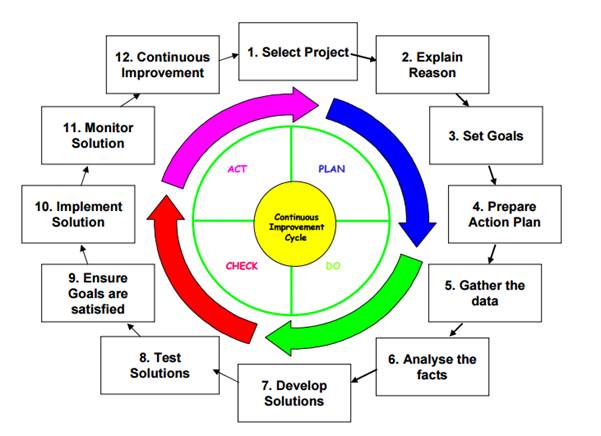
  • PDCA


Example Kaizen Event (Simple)

Problem

Order picking time too long

Baseline

  • Average picking time = 15 minutes

Actions during Kaizen

  • Rearranged layout

  • Implemented 5S

  • Reduced walking distance

  • Standardized pick sequence

Results

  • Picking time = 8 minutes

  • Errors reduced by 40%

  • Productivity improved by 30%

✅ Achieved in 4 days


Benefits of Kaizen Events

  • Fast results

  • High employee engagement

  • Visible improvement

  • Low cost

  • Builds continuous improvement culture


Common Pitfalls to Avoid ❌

  • Poor preparation

  • Vague problem statement

  • Too large scope

  • No follow-up after event

  • Management not supporting changes


Kaizen Event vs DMAIC

Kaizen EventDMAIC
Short-term (days)Long-term (months)
Rapid improvementDeep analysis
Lean-focusedLean + Six Sigma
Local scopeEnterprise scope

Success Factors ⭐

  • Clear goal & metrics

  • Strong leadership support

  • Empowered team

  • Immediate implementation

  • Sustained follow-up


One-Line Memory Tip 🧠

A Kaizen Event turns ideas into action—fast.


Comments

Popular posts from this blog

Certified Enterprise Architect Professional (CEAP) - Module 5 - Architecture Frameworks

Architecture Frameworks: An Architecture Framework is a theoretical structure that has the purpose of developing, executing, and maintaining an Enterprise Architecture. Advantages of EA framework: Simplify Breaks down areas of the business process Organise business components and create and identify relationships between business Determine the scope Customization in the existing framework Disadvantages of EA framework: Need to follow process Provides only direction and not information It's based on goal and objective Need creativity and proactive thinking Zachman Framework: The Zachman Framework is a widely used model in Enterprise Architecture (EA) that provides a structured way to classify and organize an organization's information infrastructure by defining different perspectives from various stakeholders, allowing for a holistic view of the enterprise and facilitating alignment between business needs and technology solutions; essentially acting as a template to organize arc...

Daily Agile Scrum stand-up meeting guidelines

Followers of the Scrum method of project management will typically start their day with a " stand-up meeting ". In short, this is a quick daily meeting (30 minutes or less) where the participants share the answers to the three questions with each other: • What did I accomplish yesterday?  • What will I do today?  • What obstacles are impeding my progress?  Some people are talkative and tend to wander off into Story Telling .  Some people want to engage in Problem Solving immediately after hearing a problem. Meetings that take too long tend to have low energy and participants not directly related to a long discussion will tend to be distracted. These are the minimum number of questions that satisfy the goals of daily stand-ups. Other topics of discussion (e.g., design discussions, gossip, etc.) should be deferred until after the meeting.  Here are few tips for running a smooth daily meeting:  • Everyone should literally stand-up and no one should sit down ...

Empiricism (Scrum)

Empiricism asserts that knowledge comes from experience and making decisions based on what is observed. Pillars of  Empiricism . Various practices exist to forecast progress, like burn-downs, burn-ups, or cumulative flows. While proven useful, these do not replace the importance of empiricism . In complex environments, what will happen is unknown. Only what has already happened may be used for forward-looking decision making. Each artifact contains a commitment to ensure it provides information that enhances transparency and focus against which progress can be measured: ● For the Product Backlog it is the Product Goal. ● For the Sprint Backlog it is the Sprint Goal. ● For the Increment it is the Definition of Done. These commitments exist to reinforce empiricism . The sum of the Increments is presented at the Sprint Review thus supporting empiricism .